Her Leadership, Our Future: Gender Perspectives in Higher Education's Digital Transformation
A gender perspective is an indispensable element of digital transformation in higher education. Over many years, UNESCO-ICHEI has integrated gender equality into project design and evaluation, platform development, curriculum creation, policy dialogue, and partnership collaboration. The Women Leading Change in Africa (WLCA) project represents a concentrated expression of this long-term commitment in the AI era. Co-initiated by UNESCO-ICHEI and UNESCO IITE, and relying on African HEIs, the project drives professional practice, leadership development, institutional support, and knowledge production by enhancing the digital and AI capabilities of professionals.
Gender Equality: At the Heart of Transformation
The world's first published computer algorithm was written by a woman. In 1843, while translating a paper on Charles Babbage's "Analytical Engine", British mathematician Ada Lovelace set out a complete method for calculating Bernoulli numbers. It is often called the first computer program. She also dared to imagine that the machine might one day do more than crunch numbers: that it might compose music, or create. That vision arrived more than a century before the term "artificial intelligence" was even coined.
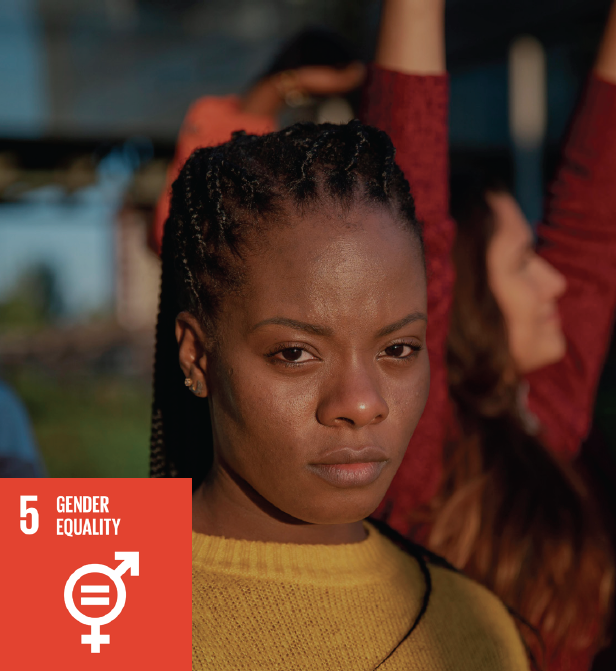
Two hundred years on, AI is indeed doing far more than arithmetic, yet women remain strikingly scarce at the frontier of this change. According to 2024 UNESCO data, women make up only around 12% of AI researchers worldwide, and roughly 20% of technical roles at major machine-learning companies.[1]
" The digital transformation we are experiencing is not gender-neutral. "
This imbalance extends to lecture theatres, laboratories, and administrative offices in universities worldwide. While AI is reshaping teaching, knowledge production, university resource allocation, and decision-making, in many regions, women still face barriers to entering certain disciplines, securing opportunities for academic development, and advancing to senior leadership positions. Social norms and gender stereotypes also hinder their participation in decision-making, access to professional support, and ability to exercise leadership. In the AI era, these existing obstacles are further compounded by a new digital divide. Engaging with the AI transition requires fresh knowledge, skills, and professional capabilities; however, if women are under-represented in data generation, technology R&D, curriculum design, and policy formulation, systems will fail to reflect their experiences and will be far more likely to perpetuate existing biases.
Higher education cannot afford to look away. Universities do more than use technology. They train the next generation of educators, researchers, engineers, administrators and public decision-makers. A responsible digital and AI transformation in higher education needs women as practitioners of educational innovation, participants in technology governance, and drivers of institutional change.
Gender inclusion, then, is not an afterthought in building an equitable, inclusive and sustainable digital future, but central to it. And everyone stands to gain, not only women: fuller, more balanced participation tends to bring higher productivity, and stronger innovation, inclusion and social cohesion.
Gender equality is one of UNESCO's two global priorities.[2] UNESCO strategy for gender equality in and through education 2026-2029 speaks of moving "from access to agency"[3] — education, in this view, should give every learner not just equal rights and opportunities, but the power to shape their own lives and futures.
That same thinking runs through its recent work on AI governance and digital skills. Women for Ethical AI (W4EAI), launched in 2024, brings together experts from across disciplines to help design AI systems that are gender-equal and in line with the Recommendation on the Ethics of Artificial Intelligence, while pushing gender onto the agenda of AI governance more broadly. Across the regions, UNESCO also runs partnership projects that bring relevant, inclusive and transformative digital skills to women and girls worldwide.
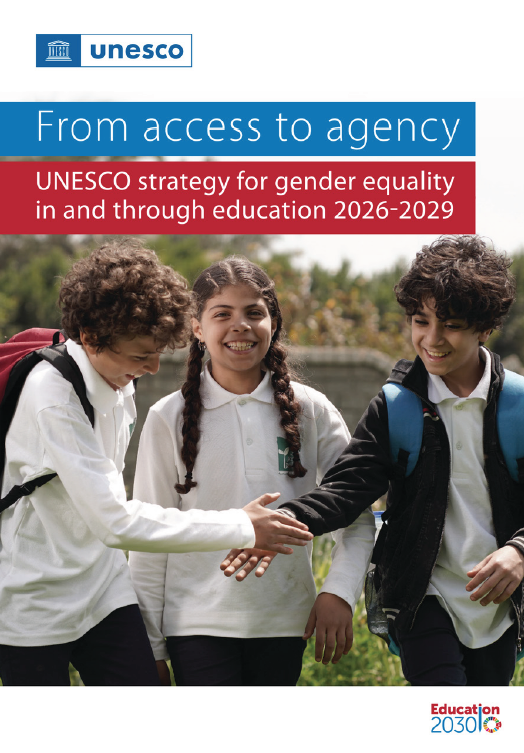
From access to agency: UNESCO strategy for gender equality in and through education 2026-2029
UNESCO-ICHEI's Long-Term Commitment and Practice
As a UNESCO Category 2 Centre, weaving gender equality into the digital transformation of higher education is a long-standing institutional commitment for UNESCO-ICHEI — one written into its very mission. Quality, equity and access have always sat at the heart of what it considers digital transformation to be about. Among the six missions of its flagship initiative, the International Institute of Online Education (IIOE), is one that speaks directly to this: to empower women and marginalised communities with greater access to quality higher education.
Project Design and Implementation
A principle only shapes practice once it enters project design, resource allocation and evaluation criteria. In 2016, UNESCO launched the UNESCO-Shenzhen Funds-in-Trust (UNESCO-SFIT) project to strengthen quality assurance in African higher education, with ICHEI commissioned by the Shenzhen Municipal Government to help design, coordinate and oversee it. Guided by a commitment to gender equality and a people-centred approach, the project kept women's participation and empowerment in view throughout — gender was factored into both participant selection and activity design for its quality-assurance capacitybuilding work.
As digital initiatives expanded, gender-disaggregated indicators were incorporated into project monitoring and evaluation. In the 2022– 2023 IIOE Pilot Projects, both the number and proportion of women taking part in professional development were key performance measures. This encouraged partner institutions to consider women's participation more deliberately in course design, staff mobilisation and project delivery. One such initiative, jointly launched by UNESCO-ICHEI and the IIOE Egypt National Centre at Ain Shams University, trained teaching staff from 20 Egyptian HEIs in digital pedagogy. More than 60% of participants were women.
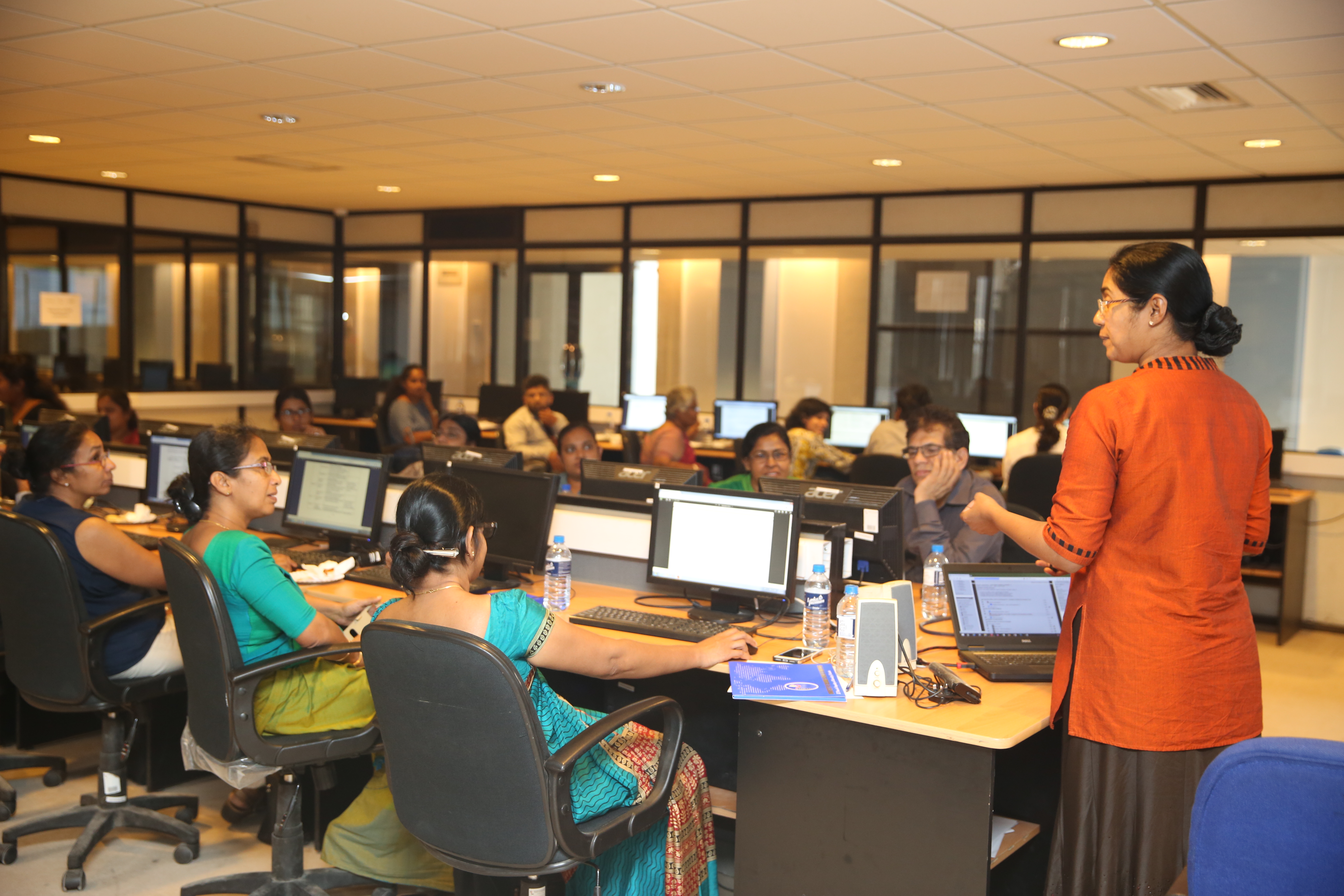
Faculty capacity-building training at the University of Colombo, Sri Lanka, under the UNESCO-SFIT Project in Asia
Platforms, Courses and Partnerships
Since launching in 2020, IIOE has provided online courses, training resources, and digital teaching support to partner HEIs worldwide, helping higher education staff enhance their digital literacy and AI capabilities. In 2024, it launched the English-language course AI, Gender and Public Policies, bringing the relationship between AI and gender equality into the curriculum. To date, the IIOE platform features over 700 courses, reaches 135 countries and regions, and has benefited nearly 400,000 higher education professionals, with female participants accounting for more than 40%.
Within the IIOE global ecosystem, a growing number of female educators and professionals are not only taking part in capacity-building initiatives, but are also emerging as a significant force in driving digital transformation. Across several partner HEIs and IIOE National Centres, female-led operations teams are actively shaping course design, project coordination, and localised implementation. By bringing their unique experiences and perspectives to project execution, they actively contribute to course promotion, learning support, and local adaptation, ensuring that capacity-building initiatives are more attentive to the needs and engagement of diverse groups.
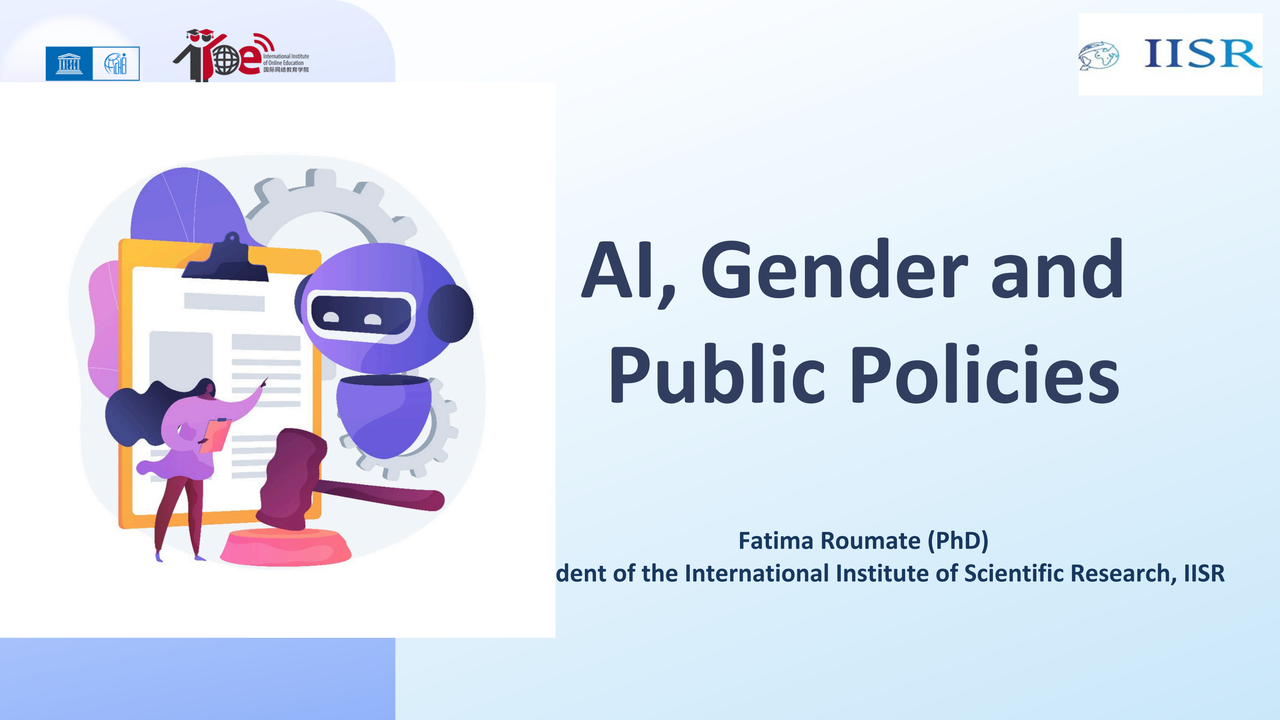
IIOE online course AI, Gender and Public Policies
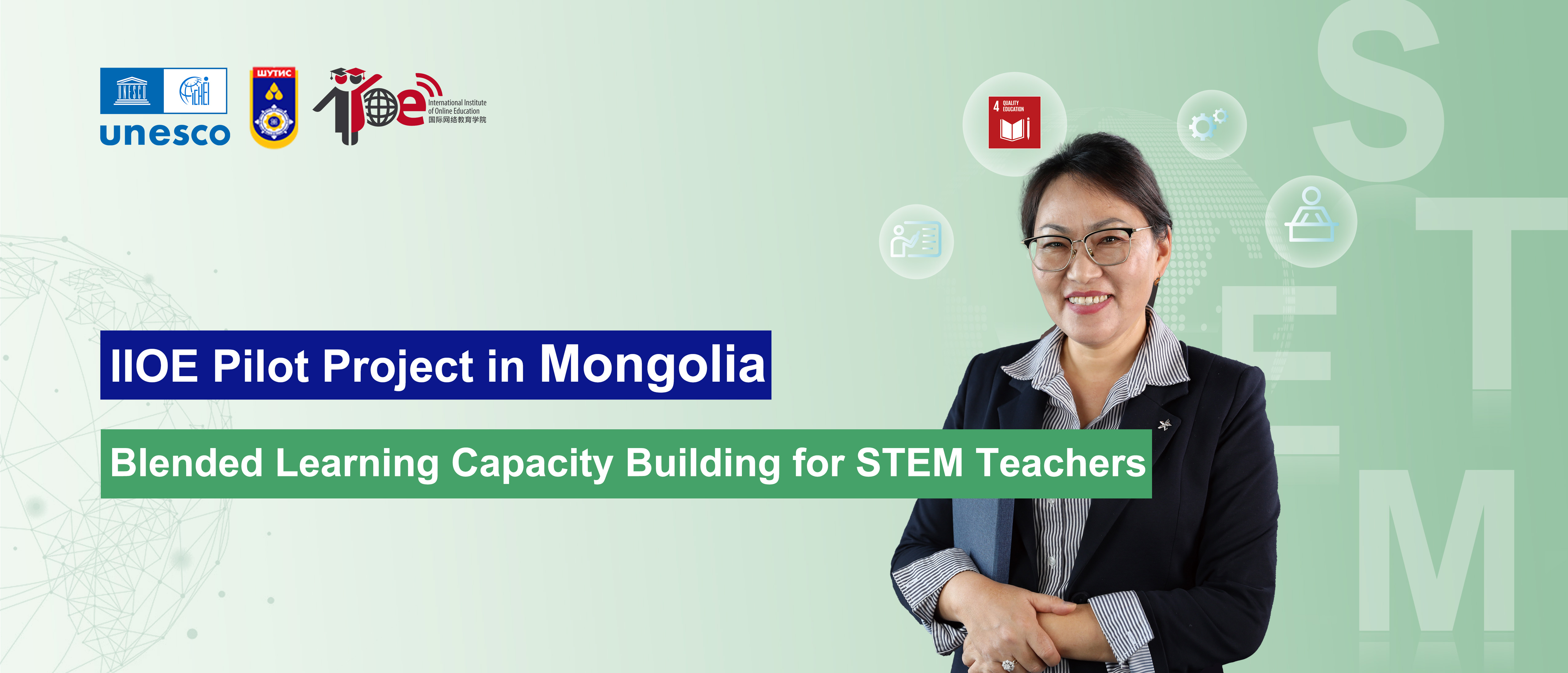
The Mongolian University of Science and Technology (MUST) partnered with UNESCO-ICHEI to implement the IIOE Pilot Project in Mongolia: Blended Learning Capacity Building for STEM Teachers. The project developed five training modules and trained 322 faculty members from 6 national universities, including 65 core faculty members, 80% of whom were women.
Dialogue, Recognition, and Shared Knowledge
Lasting change also depends on letting experience travel into wider conversations, and eventually into the wider ecosystem. The IIOE Higher Education Digitalisation Pioneer Case Award has made equity and inclusion one of its judging criteria, with particular attention to empowering women and other under-represented groups, turning inclusion into one of the yardsticks by which educational innovation itself is judged. The workshops and regional policy dialogues UNESCO-ICHEI has hosted or co-hosted, on women's leadership in STEM, women's participation, AI ethics and digital inclusion, have given educators, administrators and policymakers a space to exchange ideas and be heard. CLOUD magazine has done its own part too, documenting the experiences of women educators across countries, and using stories and data to trace the relationship between women's empowerment and the development of higher education.
Over the years, gender has found its way into how we design projects, deliver them, monitor them, generate knowledge and build partnerships — no longer an isolated concern, but a thread running through the whole of our work on transformation.
Women Leading Change in Africa
The Women Leading Change in Africa: Future Higher Education Professionals and Leadership in the Intelligence Era (WLCA) project builds on UNESCO-ICHEI's longstanding work in digital and AI capacity-building, women's empowerment and partnerships across Africa. It brings these strands together within a clearer programme framework, moving beyond access to foster leadership and institutional influence. The project serves professionals across Africa's higher education systems, with emphasis on women educators, researchers, administrators, learning-support staff and university leaders.
It is grounded in a simple principle: women should not be seen only as users of technology or classroom practitioners. They work at every level of higher education and should be able to shape digital transformation from each of those positions. By building capacity across the wider higher education workforce, the project treats gender equality not as a stand-alone issue, but as part of a more inclusive and resilient digital transformation.
In support of UNESCO's global priorities, the project contributes to the Operational Strategy for Priority Africa (OSPA) 2022–2029, particularly Flagship Programme 1, Campus Africa: Reinforcing Higher Education in Africa, and Flagship Programme 4, Harnessing new and emerging technologies for sustainable development in Africa, including through the implementation of the Recommendation on the Ethics of Artificial Intelligence.
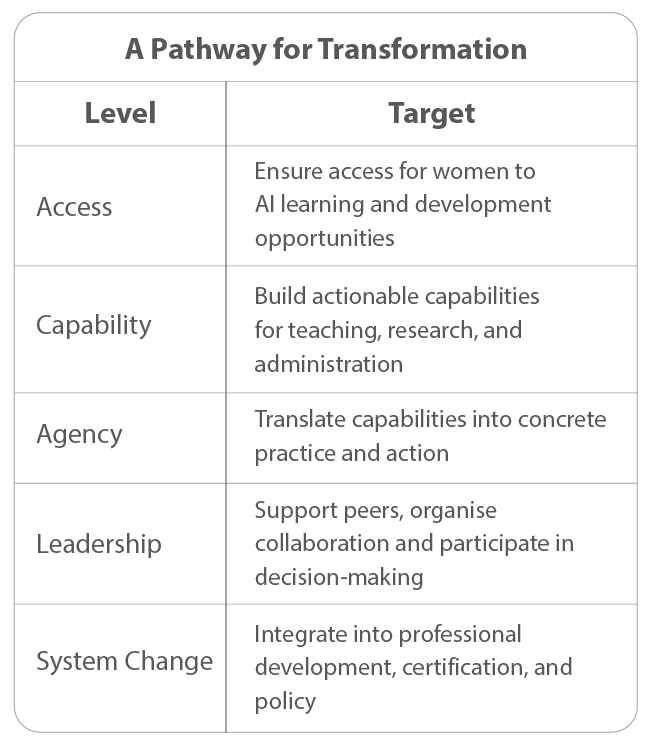
The project seeks to chart a path from women's professional and leadership development to stronger institutional capacity and lasting systemic influence.
How does change happen?
Through the IIOE platform, multilingual courses, micro-certifications, in-person training, workshops, policy dialogues, case studies and policy recommendations, the project turns principles into practical change.
Start with local needs. Countries, institutions and language contexts across Africa vary widely. Course packages are therefore tailored to local priorities, languages and standards, while targeted outreach and support encourage women to participate.
" Needs assessments, data analytics, and partner communications form an integral part of the project's methodology. "
Adapt global resources to local contexts. UNESCO-ICHEI and partners provide courses, learning platforms, tools and institutional networks. Participating universities adapt these resources through translation, content selection and training design, while aligning them with staff development systems and institutional policies. As the cases that follow show, the goals and framework remain consistent; the routes to achieving them differ.
Combine complementary forms of learning. The IIOE platform provides open, continuous and cross-border access to learning. Multilingual courses build foundational digital and AI knowledge, while micro-certifications recognise achievement through structured study and assessment. Face-to-face training connects this learning with local cases, direct exchange and practical needs, laying the groundwork for wider local delivery.
Prioritise practical application. Participants are encouraged to apply their skills in teaching, research and university administration. This may involve redesigning courses, using AI to support research and academic writing, improving administrative processes, exploring disciplinary and industry applications, addressing ethical and data concerns, or developing teaching innovations, case studies and small-scale action plans.
Extend impact through communities and dialogue. Workshops, peer exchange and policy dialogues create lasting connections among women professionals, university staff in different roles and partners across the higher education sector. These networks allow participants to share experience, collaborate and be heard, helping them move from learners to practitioners, contributors and change-makers.
Turn practice into lasting knowledge and systems. The project is not simply seeking to increase training numbers. Through joint case studies, practice reports and policy recommendations, it strengthens the evidence base on women's digital and AI capacity-building. This supports longer-term change and provides guidance for other universities wishing to develop similar initiatives.
Multi-Stakeholder Partnerships
Building a higher education transformation that is both AI-ready and gender-equal calls for a network able to connect different pools of knowledge and the actors willing to act on them. WLCA is built around exactly that: a multi-stakeholder model drawing on the resources of international organisations, higher education institutions, governments, businesses and professional networks.
As the project's initiator and coordinator, UNESCO-ICHEI draws on the IIOE platform, its courses and its wider partner network to support participating universities — offering project design support, resource coordination, help with local delivery, and channels for research and knowledge-sharing, so that each university can chart a path suited to its own needs.
The UNESCO Institute for Information Technologies in Education (UNESCO IITE) brings its expertise in digital education, ICT and AI to the table, contributing international experience, connections and technical support, and helping knowledge flow more freely across the UNESCO system.

The 2019 Training Workshop on ICT Applications in Higher Education for Asian and European Countries
Participating universities are where the project actually happens. As local implementers, they recruit participants, run training, build communities, and gather data and feedback; they work courses into their own faculty development systems, open up policy conversations on campus and beyond, and turn what they learn into case studies and recommendations.
Governments, enterprises, and UNESCO's headquarters and field offices extend the project's reach further still. In Egypt, Ain Shams University has drawn on corporate support to advance women's leadership in digital education; in Nigeria, policy dialogue has placed women's participation in AI transformation within a broader governance conversation; in Zambia, a national higher education network has driven collaboration across institutions. No single university, these examples suggest, can carry this transformation alone. It takes an ecosystem, sustained by many hands at once.
Diverse Case Studies
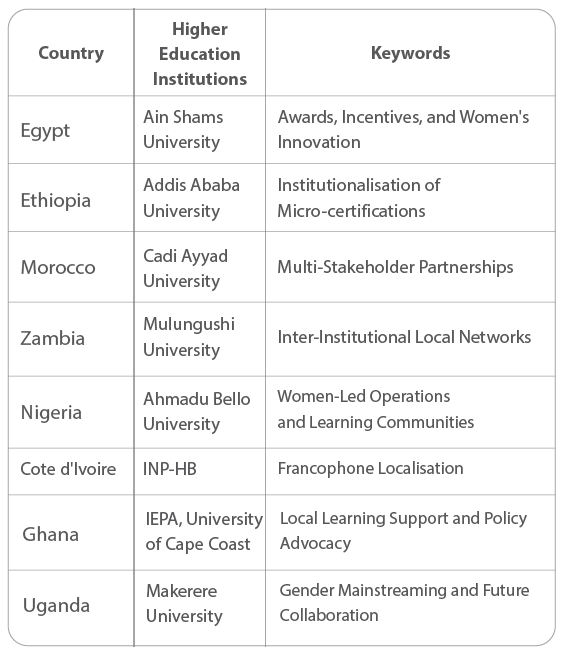
WLCA is currently under way in eight African countries — Egypt, Ethiopia, Morocco, Nigeria, Côte d'Ivoire, Ghana, Zambia and Uganda — with more partner universities expected to join.
The cases that follow are snapshots of these different journeys. Read them side by side, and a few lessons start to emerge. Open enrolment doesn't guarantee participation on its own, as targeted outreach, sustained support and learning communities are what draw more women in, and keep them there. Capability-building rarely stays confined to the individual: given time, it works its way into faculty development, institutional governance and policy, leaving something more lasting behind. And collaboration across institutions and borders is less about repeating a formula than about trading experience, adjusting course, and learning together as you go.
If there's one thing WLCA's work makes clear, it's that access to technology and learning opportunities is only where things begin. For learning to leave a lasting mark, it needs institutional backing, real structural support, a sense of community, and space to put what's learned into teaching, research and the running of an institution. The project started in Africa, but it isn't stopping there. The question it's answering is one the whole of higher education is grappling with; the approach it's testing, we hope, will keep growing well beyond where it began.
" Technology has arrived at the future Ada Lovelace once imagined. And more women like her are stepping into it — this time, by choice. "
References:
[1] UNESCO, "Women's Access to and Participation in Technological Developments," UNESCO.org, n.d.
[2] UNESCO, "Gender Equality and Education," UNESCO.org, n.d.
[3] UNESCO, "From Access to Agency: UNESCO Strategy for Gender Equality in and through Education 2026–2029," UNESCO, July 2026.

- From Readiness to Momentum: Women Leading AI Change at INP-HB
- Makerere's Leadership Experience: Initiatives, Barriers and AI Hopes for the Future
- Bridging the Divide: Empowering Ghanaian Female Educational Leaders in the Intelligence Era
- Building Women's Leadership through Learning, Networks and Partnerships: The UCA Experience
- Mulungushi University: Zambia's Journey Towards Inclusive AI Leadership in Higher Education
- Ahmadu Bello University: Building Women's Confidence in AI Through Practical Learning and Community
- Featuring Ethiopia's Experience in Advancing Women's Leadership in Higher Education Institutions
- From Access to Agency: Ain Shams University Advances Women's Digital Leadership